
In het Nederlands, met de DPIA-lijst van de AP: het AI & DPIA-checkpakket (NL) →
AI & DPIA Check Pack (EU)
Does your AI use need a DPIA, and what does the AI Act ask of you?
- Instant download
- 14-day money-back guarantee
- VAT invoice by email
- iDEAL or card
In about an hour you screen every AI use in your organisation, see which ones need a data protection impact assessment (DPIA) under GDPR Article 35 and which EU AI Act duties apply, and keep a dated record of your reasoning. A screen, not a legal opinion: you decide, the files count, flag and explain.
Instant download: one .zip with a flowchart, a workbook, two Word templates and a read-me (PDF / Excel / Word, 7 files). Free check or the pack? The comparison is just below.
Free check or the pack?
Start free if you want a quick answer for one or a few AI uses. Take the pack when you need a record you can show later: what you decided per AI use, why, who decided and when you look again, and the DPIA itself where one is needed.
Free check and sheet €0
- The online DPIA check: one AI use at a time, in your browser, nothing stored
- The screening sheet (.xlsx): up to 10 AI uses, the same rules, a result per use
- Both screen only: no register, no decision or sign-off, no DPIA template
No sign-up. The sheet download is on the same page as the check.
Try the free check →Pack €39
- A workbook for up to 100 AI uses: AI register, DPIA screening, AI Act check (with FRIA and Article 22 flags) and an overview with the next step per use
- Per use: your decision, reasoning, who decided, the date, and review dates
- The flowchart, a DPIA template for AI use, questions for your AI supplier and a read-me
The .zip holds 7 files: 00-Read-me-first.pdf and .md, 01-AI-DPIA-Flowchart.pdf, 02-AI-Use-and-DPIA-Screening-Workbook.xlsx, 03-DPIA-Template-for-AI-Use.docx, 04-AI-Vendor-Questions.docx, LICENSE.txt
Buy the pack – €39 incl. VAT →What's inside
- 00 Read me first (PDF and Markdown): how to get through it in an hour, what is in the pack, and its limits.
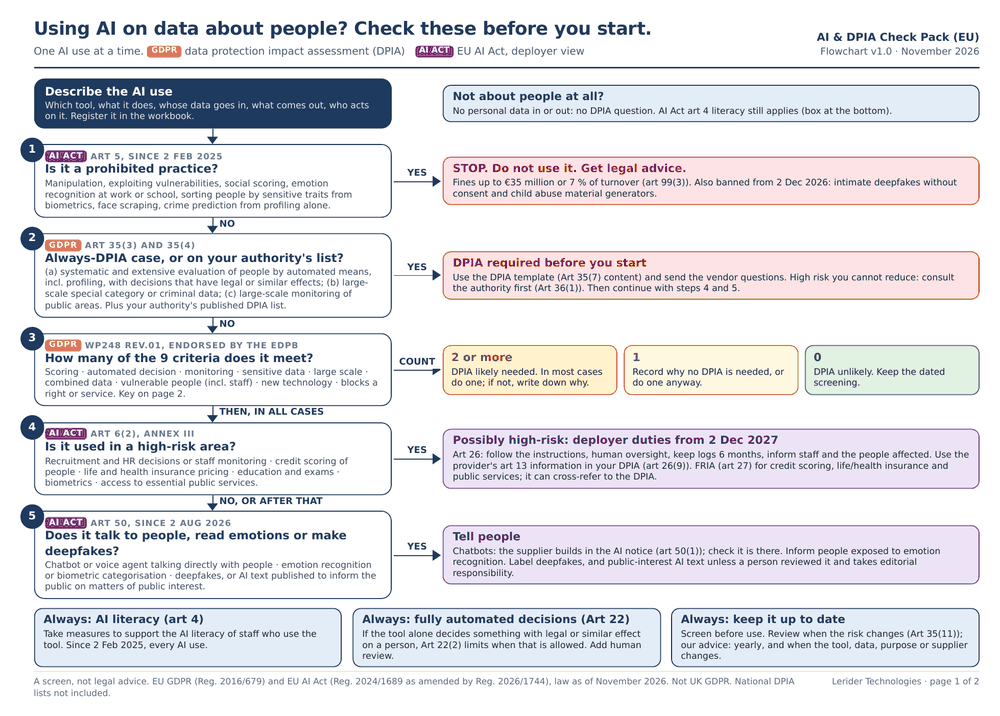
- 01 AI and DPIA flowchart (PDF, 2 pages A4 landscape): page 1 is the one-page decision flowchart for the AI Act and the DPIA; page 2 is the key with the nine criteria, the articles, the dates and the fines.
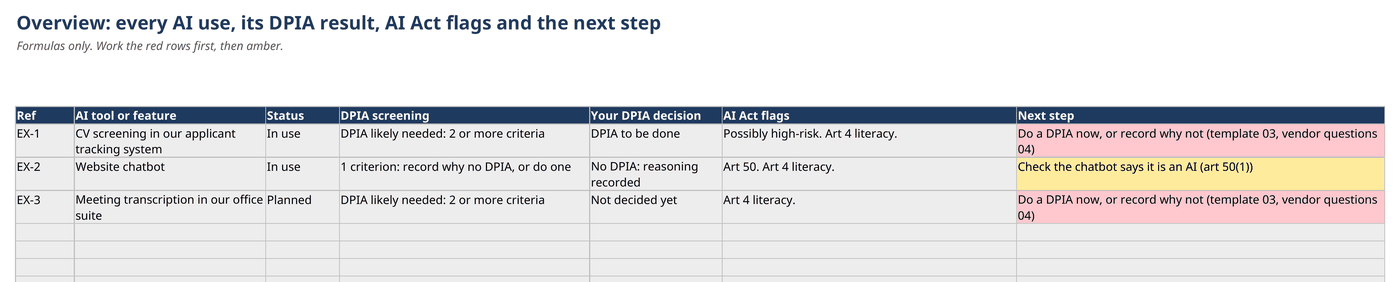
- 02 AI use and DPIA screening workbook (.xlsx, no macros): seven tabs: an AI register, the DPIA screening (nine criteria, the Article 35(3) cases and a question for your national list), an AI Act check, an overview, a guide to the nine criteria with AI examples, instructions and the drop-down lists. The register, screening and AI Act tabs have 100 rows each; the first three are examples you clear. Opens in Excel and LibreOffice.
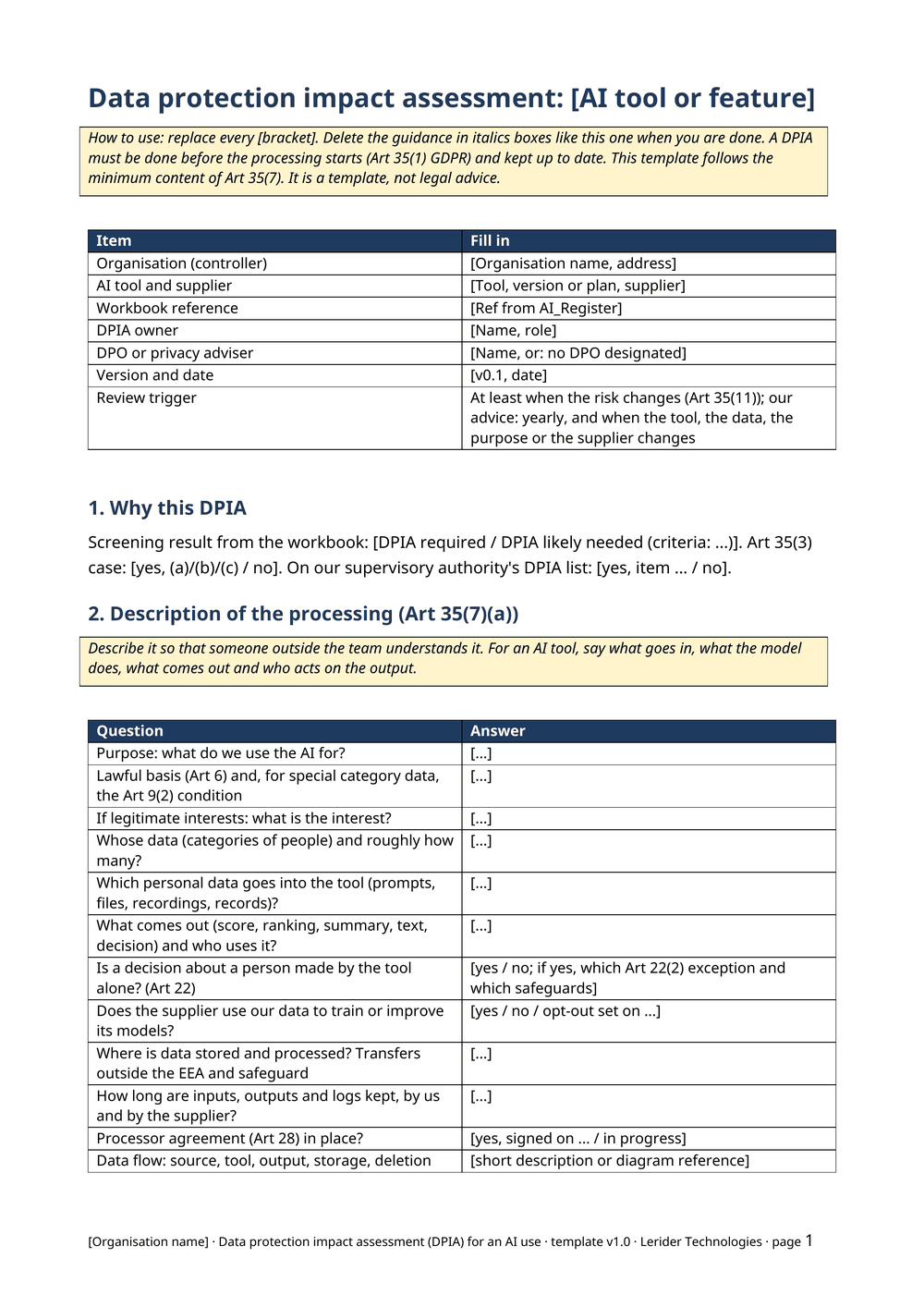
- 03 DPIA template for AI use (.docx): the Article 35(7) structure with prompts for AI, a risk table, sign-off, a review trigger and a cross-reference to a fundamental rights impact assessment (AI Act Article 27(4)).
- 04 AI vendor questions (.docx): what to ask the supplier of an AI tool for your DPIA: use of your data for training, location, retention, sub-processors, the provider's instructions for use (Article 13), accuracy, logs and human oversight.
- Licence (.txt): one organisation, including its group companies.
Want to try the logic first? The free DPIA check for one AI use follows the same screening order as the workbook.
Read a sample document (PDF, 4 pages): the questions for your AI supplier in full and the first two pages of the DPIA template, exactly as they come in the pack.
Sample pages from the pack (click to enlarge)
How it works
- List your AI uses in the AI register: chatbots, copilots, AI features in your HR, CRM or marketing tools, scoring, transcription, CV screening.
- Screen each use. First the prohibited practices of AI Act Article 5. Then the DPIA: one of the three Article 35(3) cases or your national list means a DPIA is required; otherwise you count the nine criteria of the EDPB-endorsed guidelines (WP248 rev.01). Two or more: a DPIA is likely needed. One: record why you do not do one, or do one. None: a DPIA is unlikely, and you keep the screening.
- Check the AI Act flags: possibly high-risk (Annex III, deployer duties from 2 December 2027), transparency (Article 50), and AI literacy (Article 4) for every use.
- Act on the result. For the uses that need one, start the DPIA from the template and send the vendor questions to the supplier. Keep the workbook as your dated record.
Why this matters for AI: GDPR Article 35(1) mentions new technologies, and the guidelines list innovative use as a criterion. Many AI uses also meet a second one, for example scoring people or processing data about employees. So many small organisations reach two criteria without realising it. Not every AI use needs a DPIA, and the workbook shows you which ones do.
Who this is for
- Small EU organisations, about 2 to 250 staff, that use AI tools on data about customers, staff, applicants or patients, and have no privacy team.
- The person who has to answer "did we check this?" when a new AI tool or AI feature arrives.
Who this is not for
- Organisations that build AI systems or put their name on one: you may then be a provider under the AI Act, with more duties than this pack covers.
- Organisations under the UK GDPR: the pack follows the EU GDPR.
- Anyone looking for someone to judge their AI use or write the DPIA for them: this is a tool you fill in yourself, not advice.
- One or two AI uses and no need to keep a record: the free check may be all you need.
Limits
- A screen, not a legal opinion. The files count, flag and explain; you decide.
- EU GDPR and the EU AI Act only. Not written for the UK GDPR.
- National DPIA lists are not included: you check your own authority's list, with one tick-box per AI use.
- The DPIA template gives the structure and the prompts. You still write the DPIA for your own situation.
- A proposal to change the GDPR (including EU-wide DPIA lists) is not in force as of November 2026; the pack follows the law as it stands.
FAQ
- What does the pack add to the free check and sheet?
- The free check and sheet screen with the same rules and stop there. The pack keeps the record: an AI register, your decision and reasoning per use, who decided and when, review dates and an overview of all your AI uses. It also adds a DPIA template for AI use, questions for your AI supplier and the flowchart.
- Does every AI tool need a DPIA?
- No. GDPR asks for a DPIA when processing is likely to result in a high risk to people. Many AI uses on personal data meet two of the nine criteria, and then a DPIA is likely needed; others meet one or none. The workbook helps you sort them and keep the reasons on file.
- Does the pack decide for us?
- No. It follows the rules in GDPR Article 35, the EDPB-endorsed guidelines and the AI Act, and shows the result of your own answers. You decide, and you can write down why.
- What happens if a required DPIA is not done?
- It falls under Article 83(4)(a) GDPR, with fines of up to €10 million or 2% of worldwide annual turnover, whichever is higher.
- Is this legal advice?
- No. It is a screening tool and templates, not legal advice, and there is no guarantee that your organisation meets the GDPR or the AI Act. Ask a lawyer when the result is unclear or the stakes are high.
- Which software does this work in?
- Standard .xlsx, .docx and .pdf files. The workbook opens in Excel and LibreOffice and has no macros.
- We built our own AI tool. Does the pack cover that?
- Only your use of it. If you build an AI system or put your name on one, you may be a provider under the AI Act, with more duties than this pack covers.
- Licence
- One organisation, including its group companies. No resale or sharing.
Further reading (free articles)
A screen, not a legal opinion, and no guarantee of compliance with any law. Written for the EU (EU GDPR and the EU AI Act as amended by Regulation (EU) 2026/1744), checked on 12 November 2026. Prepared with the help of AI under the direction of Lerider Technologies and checked against its references before publication.
Refunds: if this pack isn't useful for you, email hello@lerider.com within 14 days of purchase for a full refund, no questions asked.
At checkout you accept our terms (Dutch, with an English summary). See also refunds and privacy.