Free ISO 27001 gap check: where does your company stand on the 93 Annex A controls?

24 short questions instead of 93 controls. Each question covers a group of related controls of ISO/IEC 27001:2022 Annex A, sorted by the standard's four themes. Three extra questions skip the parts that often do not apply to a small company, such as an office you do not have. You get your coverage per theme, your gaps by control number, and the controls you can probably leave out with a reason.

The check

Answer Yes only when every part of the question is in place and you could show it (a document, a setting, a record). Answer Partly when some of it is. Not sure counts as open. It takes about five minutes.

This check needs JavaScript to show the result. Without JavaScript you can still use the questions as a checklist: "How the check works" below lists the controls behind each question.
Organisational controls (5.1 to 5.37)

1 Do you have a written information security policy approved by management, with named people responsible for security, and does someone check from time to time that the rules are followed?

Yes needs all three: an approved policy, named roles, and a regular check, now and then by someone who does not do the work itself. Controls 5.1, 5.2, 5.4, 5.35, 5.36.

2 Do you keep contact details for the authorities you may need in an incident, follow security alerts from your national CSIRT or sector, and act on them?

For example the data protection authority, the national CSIRT and the police. Controls 5.5, 5.6, 5.7.

3 Do you think about security when you start a project (a new system, a move to another cloud service), and are your routine IT tasks written down as procedures?

Controls 5.8, 5.37.

4 Do you keep a list of your devices, systems and important information with an owner for each, rules for how they may be used, and a step to get everything back when someone leaves?

Controls 5.9, 5.10, 5.11.

5 Do you sort information into classes (for example public, internal, confidential), mark documents and files with their class, and have rules for sending or sharing information?

Controls 5.12, 5.13, 5.14.

6 Do you have rules for who gets access to what, a joiner / mover / leaver process for accounts, passwords managed (for example a password manager), access reviewed regularly, and conflicting tasks split between people?

Split tasks: for example, one person enters a payment and another approves it. Controls 5.3, 5.15, 5.16, 5.17, 5.18.

7 Do you check the security of suppliers and cloud services before you sign, put security requirements in their contracts, and review them and their changes regularly?

Including the cloud services you use every day, such as email and file storage. Controls 5.19 to 5.23.

8 Do you have an incident response plan that says who does what, how you judge how serious an event is, how you keep evidence, and how you learn from incidents afterwards?

Controls 5.24 to 5.28.

9 Do you know how long you can do without each important system, have you tested that you can bring it back in time, and do you know how to keep security in place during a disruption?

Controls 5.29, 5.30.

10 Do you keep a list of the laws, regulations and contracts that set security or privacy requirements for you, and do you handle software licences, records and personal data in line with them?

For example the GDPR, NIS2 where it applies to you or your customers, and customer contracts. Controls 5.31 to 5.34.

People controls (6.1 to 6.8)

11 When you hire: do you run the background checks your law allows, put security and confidentiality duties in contracts or agreements, and make clear which duties continue after someone leaves or changes role?

Controls 6.1, 6.2, 6.5, 6.6.

12 Does everyone get security awareness training when they join and again at least once a year, and is there a known process for what happens when someone breaks the security rules?

Controls 6.3, 6.4.

13 Are there rules for working from home and on the road, and do staff know how and where to report something suspicious?

Controls 6.7, 6.8.

Physical controls (7.1 to 7.14)

A Do you have your own office, server room or other space whose physical security you manage yourself?

Shortcut for small companies. "No" skips question 14: those controls are then listed as ones you can probably leave out, with a reason.

14 Are your premises and any sensitive rooms protected: locks or passes, a record of who can get in, an alarm or cameras, and rules for working in protected rooms?

Controls 7.1, 7.2, 7.3, 7.4, 7.6.

B Do you run servers or network equipment yourself, beyond a normal home or office router?

Shortcut. "No" takes power supply (7.11) and cabling (7.12) out of question 15.

15 Is your equipment placed and protected against fire, water and other hazards and regularly maintained, and, if you run your own servers, protected against power failure with its cabling protected?

Controls 7.5, 7.8, 7.13, and 7.11, 7.12 if you run your own servers.

16 Do you have a clear-desk and screen-lock rule, rules for laptops and phones away from the office, rules for USB sticks and other storage media, and a safe way to wipe or destroy old devices?

These usually apply even without an office of your own. Controls 7.7, 7.9, 7.10, 7.14.

Technological controls (8.1 to 8.34)

17 Are laptops and phones protected (for example encryption and a screen lock), with malware protection, security updates installed promptly, and only approved software installed?

Controls 8.1, 8.7, 8.8, 8.19.

18 Do administrators use separate admin accounts, is access to information limited to those who need it, is multi-factor authentication on for all important accounts, and are tools that can bypass security limited to a few people?

Controls 8.2, 8.3, 8.5, 8.18.

19 Do you have standard secure settings for devices and systems, a way to approve and record changes, security requirements when you buy or build an application, and care when audits test live systems?

Changes include settings in your office suite or cloud admin portal, not only software. Controls 8.9, 8.26, 8.32, 8.34.

20 Do you delete information when it is no longer needed, hide or pseudonymise data where full data is not needed, have measures against data leaking out, and rules for encryption and keys?

Controls 8.10, 8.11, 8.12, 8.24.

21 Are backups made, protected and test-restored, do you know which systems need a spare or failover, and do you keep an eye on capacity (storage, licences, bandwidth)?

Controls 8.6, 8.13, 8.14.

22 Are logs of sign-ins and important events kept and protected, is someone alerted to unusual activity, and are system clocks synchronised?

Controls 8.15, 8.16, 8.17.

23 Is your network secured (firewall, Wi-Fi with a strong key, guests kept on a separate network), are network services such as your internet line and VPN set up securely, and are known harmful websites blocked?

Controls 8.20 to 8.23.

C Do you write software or scripts, or have software built for you?

Shortcut. Automation scripts and configuration kept as code count as "yes". "No" skips question 24.

24 Is your software work secured: who can read or change program code, secure design and coding rules, security tests before go-live, building, trying out and live systems kept apart, test data protected, and outsourced development checked?

Controls 8.4, 8.25, 8.27 to 8.31, 8.33.

Answer every question to see your result (27 left).

A self-assessment based on your own answers. Not an audit, not a certification and not advice. Certification also needs the management-system part of the standard (clauses 4 to 10: scope, risk assessment, internal audit, management review), which this check does not cover, and an audit by an accredited certification body.

2-minute video: what is in our ISO 27001 Policy Starter Bundle, the paid pack this check points to · synthetic voice

How the check works

ISO/IEC 27001:2022 Annex A lists 93 controls in four themes: organisational (37), people (8), physical (14) and technological (34). The check groups related controls into 24 questions, so each control is asked about exactly once. Your answer to a question counts for every control in it.

QuestionTopicControls
1Policy, roles, compliance checks5.1, 5.2, 5.4, 5.35, 5.36
2Authorities, alerts, threat information5.5 to 5.7
3Projects and IT procedures5.8, 5.37
4Assets, use, return5.9 to 5.11
5Classifying, labelling, sharing5.12 to 5.14
6Access, identities, passwords, split tasks5.3, 5.15 to 5.18
7Suppliers and cloud services5.19 to 5.23
8Incidents and evidence5.24 to 5.28
9Continuity5.29, 5.30
10Laws, licences, records, privacy5.31 to 5.34
11Hiring, contracts, leaving6.1, 6.2, 6.5, 6.6
12Awareness and discipline6.3, 6.4
13Remote work and reporting6.7, 6.8
14Premises and secure rooms (skipped if A = no)7.1 to 7.4, 7.6
15Equipment, hazards, power, cabling (power and cabling skipped if B = no)7.5, 7.8, 7.11 to 7.13
16Clear desk, devices away, media, disposal7.7, 7.9, 7.10, 7.14
17Devices, malware, updates, software8.1, 8.7, 8.8, 8.19
18Admin rights, access, MFA, powerful tools8.2, 8.3, 8.5, 8.18
19Configuration, changes, buying applications, audits8.9, 8.26, 8.32, 8.34
20Deletion, masking, leak prevention, encryption8.10 to 8.12, 8.24
21Backup, redundancy, capacity8.6, 8.13, 8.14
22Logging, monitoring, clocks8.15 to 8.17
23Network security8.20 to 8.23
24Software development (skipped if C = no)8.4, 8.25, 8.27 to 8.31, 8.33

The shortcut questions A to C mark 15 controls as ones small companies often leave out with a reason: physical controls for firms without premises of their own, power and cabling for firms whose systems run in the cloud, and software development controls for firms that write no code. Control 8.26 stays in: it also covers applications you buy.

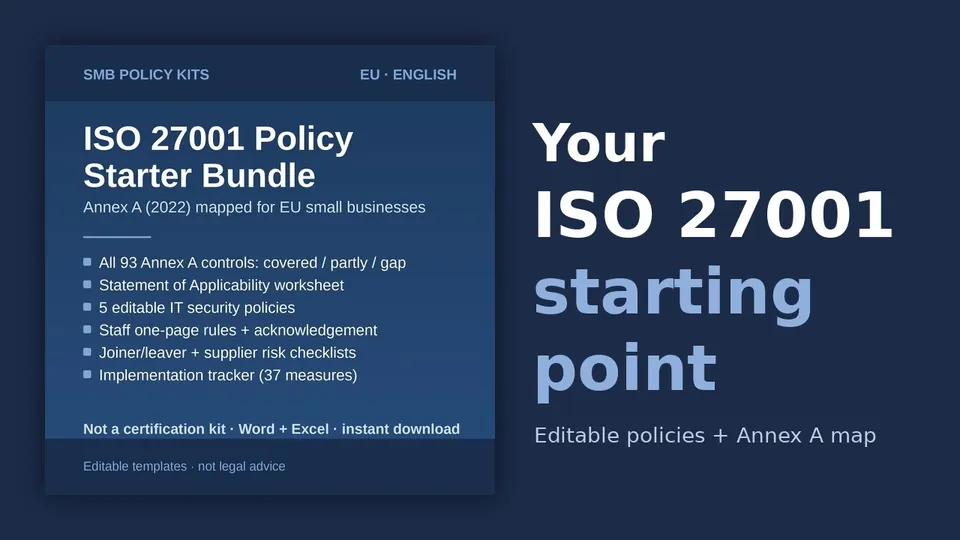
The bundle column comes from the Annex A map in our ISO 27001 Policy Starter Bundle. As delivered, the bundle covers 21 controls, covers 33 partly and leaves 39 open. The check shows how that lines up with your own gaps.

Frequently asked questions

Does a good score mean we are ISO 27001 compliant?

No. The check works from your own answers, and it covers Annex A only. Certification also needs the management system of clauses 4 to 10 (scope, risk assessment, internal audit, management review) and an audit by an accredited certification body.

Are my answers stored?

No. The check runs in your browser. Nothing is stored or sent, and no cookies are used.

Why 24 questions and not 93?

Many controls belong together, such as the five on suppliers and cloud services. Grouping them gives a first picture in minutes. For a Statement of Applicability you still decide on each of the 93 controls separately.

Can we really leave out the physical controls?

Some of them, if you have no premises of your own, and always with a written reason. Laptops, papers and old devices still need care (7.7, 7.9, 7.10, 7.14), so question 16 stays in.

Official sources

This check and this page are general information, not legal or audit advice, and not a certification or a statement of compliance. ISO/IEC 27001 is referred to by clause and control numbers only, with our own short descriptions; the text of the standard is not reproduced here. Buy the standard from ISO or your national standards body if you need it. Lerider Technologies is not affiliated with ISO or IEC. Drafted with the help of AI and checked against the sources listed above before publication.